- razee
- June 29, 2026
- Business
- 0 Comments
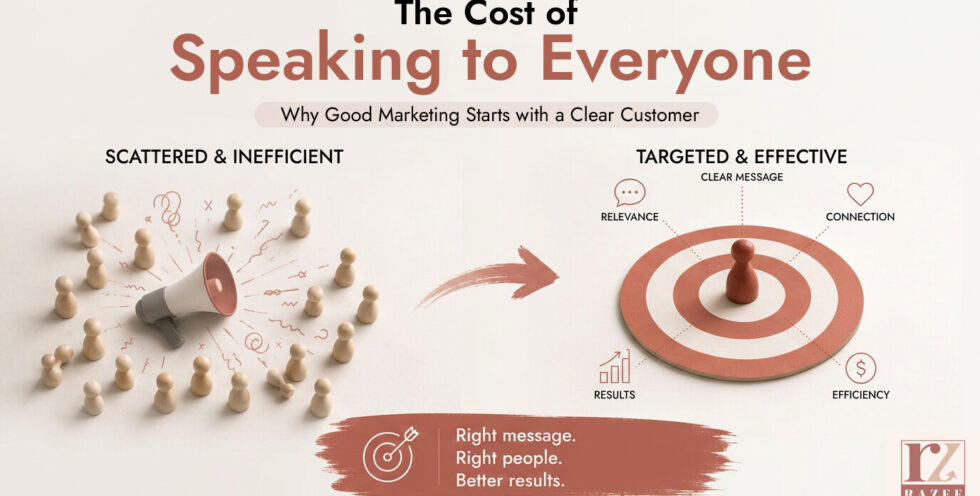
The Cost of Speaking to Everyone: Why Good Marketing Starts with a Clear Customer
Most businesses do not struggle because they are invisible.
They struggle because people do not feel spoken to.
And there is a huge difference between those two things.
A business can post every day, run ads consistently, redesign its website twice a year, and still feel disconnected from the audience it is trying to attract.
That disconnect usually comes from one place:
The messaging is trying to reach everyone.
At first, that feels like the smart thing to do. More people should mean more opportunities, right?
But in reality, broad messaging often creates weak marketing.
Because the moment a business starts trying to appeal to everyone, the communication loses sharpness. The brand starts sounding generic. The content becomes forgettable. And customers stop feeling emotionally connected to what they are seeing.
The strongest brands in the world do the opposite.
Nike does not speak to everyone.
Dove does not speak to everyone.
Louis Vuitton does not speak to everyone.
BMW definitely does not speak to everyone.
And that is exactly why their marketing feels powerful.
Table of Contents
ToggleWhy Most Businesses Struggle With Audience Clarity
A lot of founders believe narrowing their audience means limiting growth.
So the messaging becomes very safe.
The website says:
“We work with all industries.”
The social media content tries to appeal to every kind of customer.
The brand tone changes constantly because the business is trying to fit too many different people at once.
And honestly, this happens because business owners are trying to avoid missing opportunities.
But the strange thing is this:
The more broadly businesses communicate, the harder it becomes for customers to emotionally connect.
Because people pay attention when something feels specifically relevant to them.
Not generic.
Not vague.
Not designed for “everyone.”
Specificity creates emotional recognition.
And emotional recognition is what makes marketing memorable.
“When your audience is unclear, your message becomes weak. When your audience is sharp, your marketing becomes powerful.”
What Happens When Your Marketing Tries to Speak to Everyone
You can usually feel this problem immediately when reading certain websites.
The messaging feels overloaded.
Too many services.
Too many promises.
Too many different customer types being mentioned at once.
Nothing feels grounded.
And over time, that creates bigger problems underneath the surface.
The ads attract inconsistent leads.
The content feels disconnected.
The website gets harder to navigate.
The brand tone changes depending on the platform.
Eventually, even the business itself starts feeling confused about its own positioning.
This is why audience clarity matters so much.
Not because narrowing your audience limits growth.
Because narrowing your audience strengthens communication.
And strong communication changes everything.
The Nike Case Study and the Power of Identity-Based Marketing
Nike is one of the best examples of what happens when a brand deeply understands the identity of the people it is speaking to.
Nike does not market shoes.
It markets ambition.
Discipline.
Resilience.
Performance.
Mental toughness.
Personal transformation.
Even people who barely work out still emotionally connect with Nike because the brand speaks to something deeper than fitness.
It speaks to identity.
That is why “Just Do It” became iconic.
Not because it was clever copywriting.
It emotionally connected with people who wanted to feel stronger, braver, more determined, and more capable in their own lives.
Nike understood something incredibly important:
People do not only buy products.
They buy versions of themselves.
And because Nike knows exactly who it is speaking to, the brand feels incredibly consistent across everything:
campaigns
athletes
storytelling
visuals
messaging
emotional tone
The marketing always reinforces the same identity.
That clarity is what gives the brand power.
Imagine if Nike suddenly started trying to market equally to luxury fashion audiences, wellness retreats, budget shoppers, and corporate executives all at once.
The messaging would collapse instantly.
The brand feels strong because the audience clarity is strong.
“The strongest brands are not built around products. They are built around people and identity.”
What Dove Understood About Emotional Connection
Dove did something many beauty brands avoided for years.
It stopped selling perfection.
For decades, the beauty industry heavily relied on aspiration marketing. Perfect skin. Perfect bodies. Perfect standards.
And eventually, audiences became emotionally exhausted by it.
Dove recognized that frustration before many others did.
Instead of speaking to people chasing perfection, Dove started speaking to people craving honesty, self-acceptance, and emotional safety.
That shift changed everything.
The “Real Beauty” campaigns worked because they made audiences feel emotionally understood.
People saw themselves reflected in the campaigns in a way that felt genuine instead of performative.
And the important part here is this:
Dove did not try to appeal to every possible beauty customer.
It built strong emotional positioning around a very specific belief system.
The brand consistently reinforced:
authenticity
realness
self-acceptance
emotional trust
That clarity created emotional loyalty far deeper than product marketing alone ever could.
Because people rarely remember marketing that simply looks beautiful.
They remember marketing that makes them feel seen.
Why Luxury Brands Like Louis Vuitton Never Market Broadly
Luxury branding becomes incredibly powerful to study because luxury brands understand audience clarity at an entirely different level.
Louis Vuitton is not trying to become relatable to everyone.
And honestly, that is part of what creates its desirability.
The brand is not selling bags alone.
It is selling aspiration.
Identity.
Exclusivity.
Status.
Arrival.
When someone buys Louis Vuitton, they are often buying a feeling long before they are buying a product.
The product becomes symbolic.
It represents success, taste, access, and lifestyle.
That emotional positioning is extremely intentional.
Notice how luxury brands rarely use broad messaging.
They do not try to convince everyone to buy from them.
They create emotional worlds that certain audiences deeply want to belong to.
And because the positioning is so focused, every detail becomes aligned:
photography
store design
pricing
collaborations
campaigns
tone
exclusivity
Everything reinforces the same emotional perception repeatedly.
This is one of the biggest lessons businesses can learn from luxury branding:
Strong brands are not afraid of specificity.
In fact, specificity is often what creates premium perception in the first place.
“The more clearly a brand understands who it is for, the more emotionally valuable it becomes.”
How BMW Built Desire Through Precision Positioning
BMW is one of the clearest examples of what happens when a brand understands exactly how it wants people to feel.
It never positioned itself as “just another car company.”
From the beginning, BMW built its identity around the driving experience itself.
Performance.
Precision.
Control.
Engineering.
Confidence.
This became deeply embedded into how the brand communicated over decades.
Even the phrase “The Ultimate Driving Machine” tells you exactly who the brand is speaking to.
BMW is not trying to appeal to someone who simply wants transportation from point A to point B. It is speaking to people who emotionally connect with the feeling of driving itself. People who value performance, status, sharpness, and control.
And over decades, BMW reinforced that identity consistently across:
advertising
visual direction
product design
motorsport involvement
brand storytelling
Nothing about the brand communication felt random.
And that consistency is exactly what made BMW memorable far beyond product features alone.
Because features can explain what a product does.
But positioning explains why people emotionally care about owning it in the first place.
What Businesses in the US & Canada Need to Understand About Audience Clarity
Businesses across the US and Canada are competing in crowded digital spaces now.
Everyone is creating content.
Everyone is running ads.
Everyone is trying to “build a brand.”
That is why audience clarity matters more than ever.
Strong target audience for small business planning helps businesses stop sounding generic online.
And honestly, generic is one of the biggest problems in modern marketing.
When businesses deeply understand their audience, everything improves:
messaging
offers
campaigns
websites
lead quality
emotional connection
This is where concepts like customer persona for small business and small business customer segmentation become genuinely valuable.
Not because they sound strategic.
Because they help businesses communicate more clearly.
For Canadian founders especially, strong target audience strategy Canada planning can create major long-term advantages in crowded local and online markets.
And this is why many founders eventually seek support around small business marketing strategy Canada or work with a marketing consultant for business owners Canada.
Because good marketing rarely starts with “more content.”
It usually starts with better understanding.
What Indian Businesses and MSMEs Need to Understand About Customer Targeting
India’s digital business landscape is changing incredibly fast right now.
Thousands of businesses are becoming visible online for the first time.
But visibility alone does not create trust anymore.
This is why conversations around target audience for business in India and customer persona for Indian business are becoming much more important.
A lot of businesses still market very broadly because broader communication feels safer.
But digital platforms reward relevance now.
The businesses standing out online are usually the ones communicating with emotional clarity and consistency.
Especially for MSMEs investing in digital marketing for small business India, audience understanding becomes one of the biggest competitive advantages.
Because when businesses truly understand:
- who they serve
- what those customers value
- what emotional outcomes they seek
- what frustrations they experience
…the marketing naturally becomes sharper.
This is where strong marketing strategy for MSME planning starts becoming important.
Not louder marketing.
Clearer marketing.
And honestly, once businesses learn how to identify target customers properly, everything starts feeling more aligned internally too.
The content flows better.
The messaging sounds stronger.
The brand feels more intentional.
That clarity compounds over time.
How to Define Your Ideal Customer Without Overcomplicating It
You do not need complicated systems to understand your audience better.
Start by observing patterns.
Who naturally connects with your business already?
What emotional outcomes are they looking for?
What kind of customers feel aligned with your process and values?
Because customers are not only buying services.
They are buying feelings too.
Relief.
Growth.
Confidence.
Status.
Belonging.
Simplicity.
The businesses that understand those emotional motivations create much stronger marketing naturally.
The Real Reason Customer Personas Matter
Customer personas are not about creating fictional profiles that look impressive in presentations.
They are about creating clarity.
They help businesses stop speaking vaguely.
Once you understand your audience deeply, the marketing stops feeling forced.
Because you are no longer trying to say something that appeals to everyone.
You are communicating clearly with people you genuinely understand.
And honestly, audiences can feel that difference immediately.
Common Audience Targeting Mistakes Businesses Make
One of the biggest mistakes businesses make is believing broader messaging creates bigger growth.
Usually, it creates weaker positioning instead.
Another common issue is copying competitors too closely without understanding whether the same audience psychology applies to their own business.
And finally, many businesses focus heavily on demographics while ignoring emotional behavior completely.
But emotional behavior is often where the strongest marketing insights exist.
Because people buy emotionally first.
Logic usually comes later.
What Changes When Your Marketing Finally Speaks Clearly
When audience clarity improves, marketing starts feeling calmer.
The messaging becomes easier to write.
The website feels more aligned.
The leads become more relevant.
The content starts feeling more natural.
Even internally, businesses often feel less overwhelmed because the communication finally has direction.
That is what strong positioning actually does.
It removes noise.
And honestly, that clarity becomes one of the most valuable things a business can build long term.
Do Not Let This Mistake Cost You
The biggest marketing mistake many businesses make is trying too hard to stay broad.
Because broad messaging often creates weak emotional connection.
Nike became powerful because it understood ambition.
Dove became memorable because it understood emotional honesty.
Louis Vuitton built desire through exclusivity.
BMW built identity through precision and performance.
None of these brands tried to speak to everyone.
And that is exactly why people remember them.
At RaZee, we believe good marketing should feel intentional, emotionally clear, and deeply connected to the people it is trying to reach.
Because businesses grow faster when customers feel understood.
And if this conversation resonated with you, maybe that is the real starting point.
Not louder marketing.
Just clearer communication built around the right people.
FAQs
How does defining a target audience improve marketing?
Defining a target audience helps businesses create clearer messaging, improve lead quality, strengthen campaigns, and build better customer trust.
Why do businesses struggle with audience targeting?
Many businesses fear losing opportunities by narrowing their audience, which often leads to vague and ineffective communication.
How can small businesses identify target customers?
Small businesses can identify target customers by studying customer behavior, emotional motivations, repeated pain points, and patterns among their best existing clients.
When should businesses create customer personas?
Businesses should create customer personas before scaling marketing campaigns, paid ads, or content strategies.
Why does customer segmentation matter for small businesses?
Customer segmentation helps businesses create more relevant messaging and stronger customer connection across different audience groups.
How does audience clarity improve brand positioning?
Audience clarity helps businesses communicate more consistently, attract aligned customers, and create stronger emotional recognition in the market.